How does the tie-break work in padel?
Updated 14 November 2026
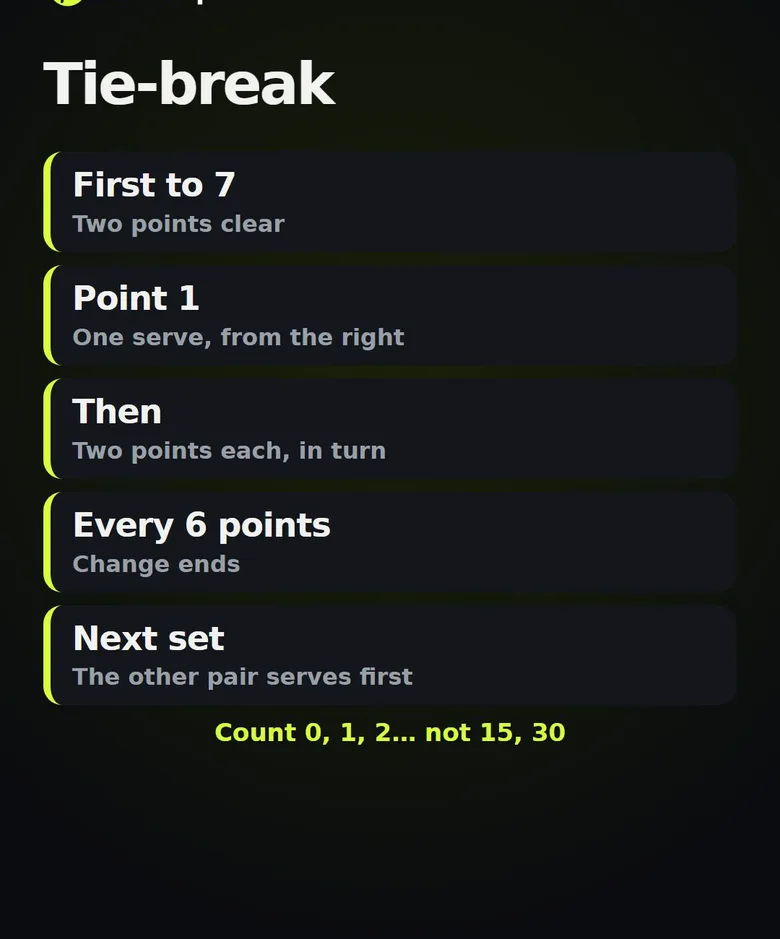
At 6–6 in a set, play a tie-break. Count the points 0, 1, 2, 3… The first pair to 7 points with a two-point lead wins the tie-break and the set 7–6. If it’s 6–6 in the tie-break, keep going until one pair is two points ahead.
The picture is from our short video on this topic, coming soon.
Who serves
- The player whose turn it is to serve plays the first point, one serve, from the right.
- The other pair then serves two points, starting from the left.
- From then on each player serves two points in a row, in the set’s serve order, to the end.
Changing ends
Change ends every 6 points (after 6, 12, 18…). In a tournament there’s a short break of up to 20 seconds; there’s no rest at the change.
The next set
The pair that did not serve first in the tie-break starts serving the next set.
Variants you may play
- Super tie-break in place of a third set: first to 10, two clear.
- Match tie-break to 7: the same, but to 7.
- In a friendly, agree before you start whether the third set is a full set, a tie-break to 7 or a super tie-break.
Try it
One point at a time. Use each change of ends, every 6 points, to say one sentence to your partner: the plan for the next points.
Film your next match and check it in Padelapu: rewatch the points, see where you both stood, send your partner the exact moment. Free, no card needed.
Sources
- FIP Rules of Padel, review of application 01.01.2026: Rule 1 (tie-break, and alternative score methods), Rule 2.10 (20 seconds at a tie-break change of ends), Rule 5.2 (change ends every 6 points).
More guides
- Super tie-break in padel: how it worksAt one set all, many tournaments play a super tie-break instead of a third set: first to 10 points, two clear.
- Your first padel tournament: what to expectWhat to bring, what to ask before the first point, how the warm-up works and what to do when it goes wrong.
- Padel mental game: what to do when the lead melts5–2 up and suddenly 5–6 down?