Padel shot glossary: bandeja, víbora, chiquita, por tres and more
Updated 16 November 2026
Most padel shot names are Spanish. Each term below has its own link, a short definition and the source it follows.
Jump to: Bandeja · Víbora · Gancho · Rulo · Por tres · Por cuatro · Bajada (de pared) · Chiquita · Globo · Contrapared · Dejada · Bloqueo · Golden point · Star point
Overheads
Bandeja
The bandeja is an overhead hit with slice from around the service line, when a lob is not deep enough to run back for and too deep to smash. You hit it deep at a controlled pace, so the ball stays low off the back glass and your pair keeps the net. The name is Spanish for “tray”: the open racket face at head height looks like one.
Sources: LTA Padel, Tennis Warehouse. More: Víbora vs bandeja, Slice on the bandeja
Víbora
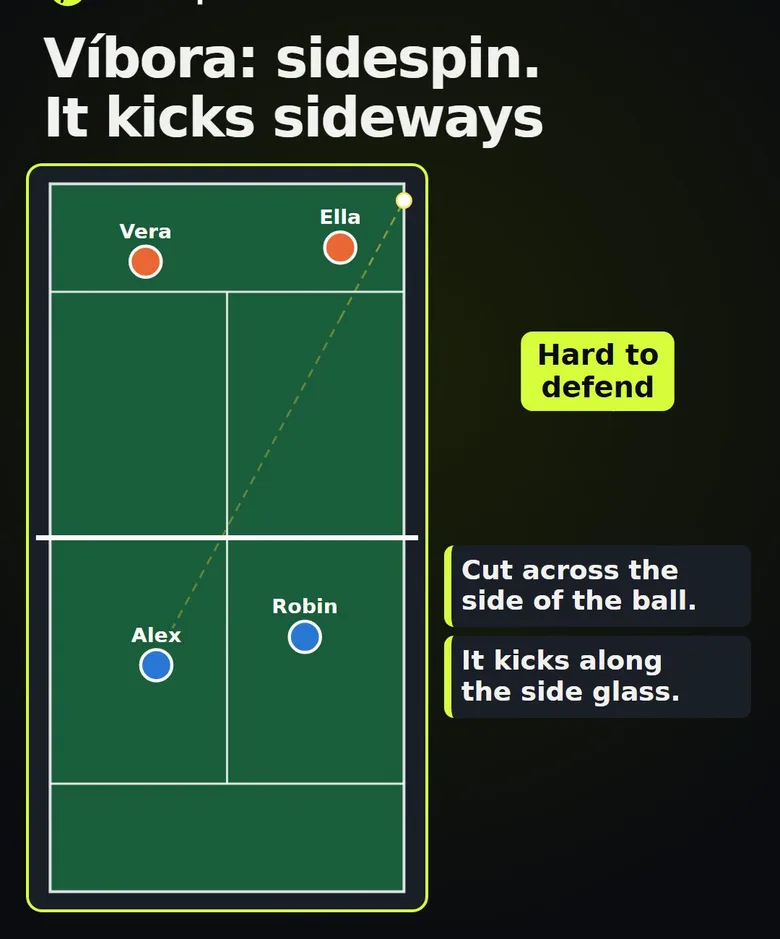
The víbora is an attacking overhead hit with sidespin mixed with slice, harder than a bandeja and usually cross-court into the side glass. The sidespin makes the ball kick low and sideways off the floor and the glass, so it is harder to defend and riskier to hit. Víbora is Spanish for “viper”.
Sources: LTA Padel, Tennis Warehouse. More: Víbora vs bandeja
Gancho
The gancho is a defensive overhead that wins back the net, much like a bandeja but met higher. It is usually hit with little or no spin and aimed at the side glass or the fence. Gancho is Spanish for “hook”.
Source: padel.fyi.
Rulo
The rulo is an overhead with topspin hit at a lob, usually aimed at the side fence, where the ball bounces in a way the defenders cannot read. It carries less risk than a flat smash. It is also called rulo a la reja, “rulo to the fence”.
Sources: LTA Padel, padel.fyi. More: Topspin: a narrow job
Por tres
Por tres is a kick smash that leaves the court over the side wall. The ball bounces on the opponents’ side, comes off their back glass and flies out over the 3 m high side wall, hence the name: “for three”. Where the court has openings and the club allows it, the opponents may run out and play it back, so it does not always win the point.
Sources: NOX, LTA Padel, padel.fyi, Tennis Warehouse. More: In or out in padel?
The other reading: one glossary, padel-rules.pages.dev’s “Padel Glossary”, uses por tres for the chiquita, a low ball at the net players’ feet. This page follows the smash reading of NOX, LTA, padel.fyi and Tennis Warehouse.
Por cuatro
Por cuatro is a flat smash, usually hit close to the net, that bounces on the opponents’ side and leaves the court over the back wall. With its fence the back wall stands 4 m high, hence the name: “for four”.
Sources: Tennis Warehouse, padel.fyi.
From the back of the court
Bajada (de pared)
The bajada, in full bajada de pared, is an attacking shot played after the opponents’ lob has bounced and come high off your back glass. You let the ball come down off the glass and hit it downwards with pace, often from above head height. Bajada is Spanish for “descent”.
Sources: LTA Padel, Tennis Warehouse.
Chiquita
The chiquita is a soft, low shot from the back of the court at the feet of the opponents at the net. They have to hit the ball upwards, which gives your pair the chance to move forward. Chiquita is Spanish for “little one”.
Sources: LTA Padel, padel.fyi. More: Padel shot selection
Globo
Globo is Spanish for lob: a high ball over the opponents at the net, deep into their back court. It pushes them away from the net and gives your pair time to take it.
Source: padel.fyi. More: Padel shot selection, Padel tips and tactics
Contrapared
Contrapared, “against the wall”, is a shot you hit into your own back wall so that the ball travels from there over the net. It is mostly a last resort in defence, when you cannot get to the ball in a better way. The rules allow your own glass, never your own fence.
Sources: padel.fyi, Tennis Warehouse. More: Can you play the ball off the fence in padel?
At the net
Dejada
The dejada is the drop shot: a soft ball, usually with backspin, that drops just over the net and stays low, so it bounces twice before the opponents reach it.
Sources: Tennis Warehouse, padel.fyi.
Bloqueo
The bloqueo is the block: a short volley at the net with almost no swing, played against a hard ball hit at you, such as a bajada. You use the ball’s own pace to keep it in play rather than attack.
Sources: padel.fyi, Padel Addict.
Scoring
Golden point
The golden point is one deciding point at 40–40: whoever wins it wins the game, with no advantage. The FIP rules allow it as one of three ways to play 40–40.
Sources: FIP Rules of Padel, LTA Padel. More: Star point, golden point or advantage?
Star point
The star point is a way to play 40–40: advantage at the first two deuces, then at the third deuce one deciding point wins the game. The FIP rules allow it alongside advantage and the golden point.
Source: FIP Rules of Padel. More: Star point, golden point or advantage?
Try it
Next time you play, name each shot your pair hits in one rally: was that a bandeja or a víbora, a chiquita or a globo?
Film your next match and check it in Padelapu: rewatch the points, see where you both stood, send your partner the exact moment. Free, no card needed.
Sources
- LTA Padel, “Padel terms and terminology explained: what do bandeja, vibora and chiquita mean?” (ltapadel.org.uk).
- Tennis Warehouse Learning Center, “Padel terminology” (tennis-warehouse.com).
- padel.fyi, “Padel Glossary” and its articles on each shot (padel.fyi/padel-terms/).
- NOX, “How to hit a 3-metre smash in padel”, 28 April 2021 (noxsport.com).
- Padel Addict, “El arte del bloqueo”, 7 May 2020 (padeladdict.com).
- FIP, Rules of Padel, Rule 1, as on our page “Star point, golden point or advantage?” (padelfip.com).
- padel-rules.pages.dev, “Padel Glossary”: the other reading of por tres only.
More guides
- Víbora vs bandeja: what’s the difference?Two overheads from the same spot, and the spin that makes the difference.
- Padel spin explained: flat, topspin and sliceFlat bounces as you expect, topspin kicks up, slice stays low.
- Padel shot selection: easy ball, in between, hard ballFewer unforced errors win sets: which shot for which ball.