Víbora vs bandeja: what’s the difference?
Updated 14 November 2026
Both are overheads you play from around the service line when a lob isn’t deep enough to run back for and too deep to smash. The bandeja is mostly slice: a controlled shot that sits low off the back glass and keeps your pair at the net. The víbora adds sidespin and more pace: the ball kicks sideways along the side glass, which makes it harder to defend and riskier to hit.
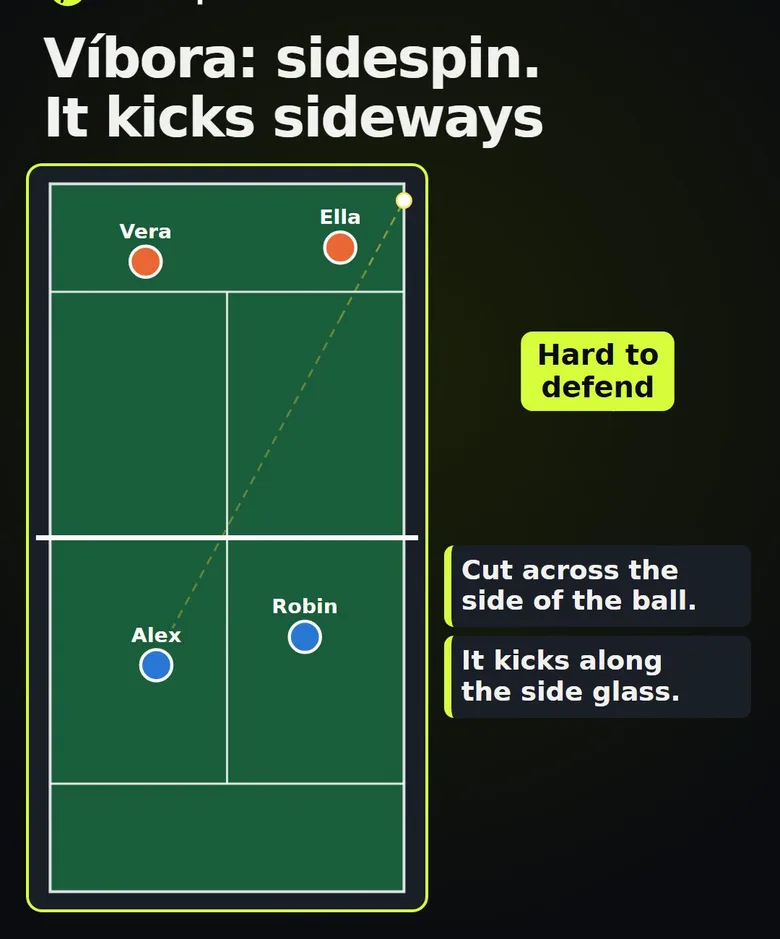
The picture is from our short video on this topic, coming soon.
Side by side
| Bandeja | Víbora | |
|---|---|---|
| Spin | Slice (backspin) | Sidespin mixed with slice |
| Pace | Slow to medium | Medium to fast |
| Aim | Deep, often the back glass or the middle | Cross-court into the side glass |
| Off the glass | Sits low, comes out slowly | Kicks along the side glass, low |
| Job | Keep the net, reset the point | Hurt them, force a weak reply |
| Risk | Low | Higher: more errors when it’s rushed |
Why the víbora is hard to defend
Sidespin makes the ball change direction when it meets the side glass. Instead of coming out where the defender expects, it runs along the glass, low. Club players often wait in the corner for it and find it has already passed, or has died at their feet.
Sidespin can speed it up or kill it
What the ball does off the side glass depends on which way it is spinning.
- Spin turning the way the ball travels: it speeds up off the glass and races away from the defender.
- Spin turning against it: it slows off the glass and dies.
Which one to play
- Lob short and you’re well set? A víbora into the side glass.
- Lob deeper, or you’re off balance? A bandeja, deep, and stay at the net.
- Not sure? The bandeja. Keeping the net is worth more than one hard overhead.
Try it
In the warm-up, play five bandejas and five víboras from the same spot. Ask your partner at the back which ones were harder to play back, and where they came off the glass.
Film your next match and check it in Padelapu: rewatch the points, see where you both stood, send your partner the exact moment. Free, no card needed.
Sources
- Padel Browser, "How to hit a víbora in padel" and "How to hit a bandeja in padel" (padelbrowser.com).
- padel.fyi, "Víbora" (padel.fyi/articles/vibora).
- The Padel School, "Padel volleys: use slice or flat?" (thepadelschool.com).
More guides
- Padel spin explained: flat, topspin and sliceFlat bounces as you expect, topspin kicks up, slice stays low.
- Left-handed padel: which side, and how to play against oneA left-hander on the right puts both forehands in the middle.
- Padel shot selection: easy ball, in between, hard ballPros made a third fewer unforced errors in 2022 than in 2016, and the pair with fewer errors usually wins the set.
- Padel net positioningWhere to stand at the net, and moving as a pair.
- Padel shot glossary: bandeja, víbora, chiquita, por tres and moreWhat each padel shot name means, in a few lines, with its source.