What is padel? Beginner questions answered
Updated 17 November 2026
Padel is a racket sport for two against two, played on a court 20 m long and 10 m wide that is closed in by glass walls and a metal fence. You serve underarm, the scoring is tennis scoring, and once the ball has bounced on your side you may play it off the walls. The racket has no strings: it is a solid, perforated paddle with a wrist cord.
Jump to: What is padel? · Where and when was padel invented? · Why is padel so popular? · Is padel an Olympic sport? · Can you play padel singles? · What do I need for my first padel game? · Are padel balls the same as tennis balls? · Do you need special shoes for padel?
What is padel?
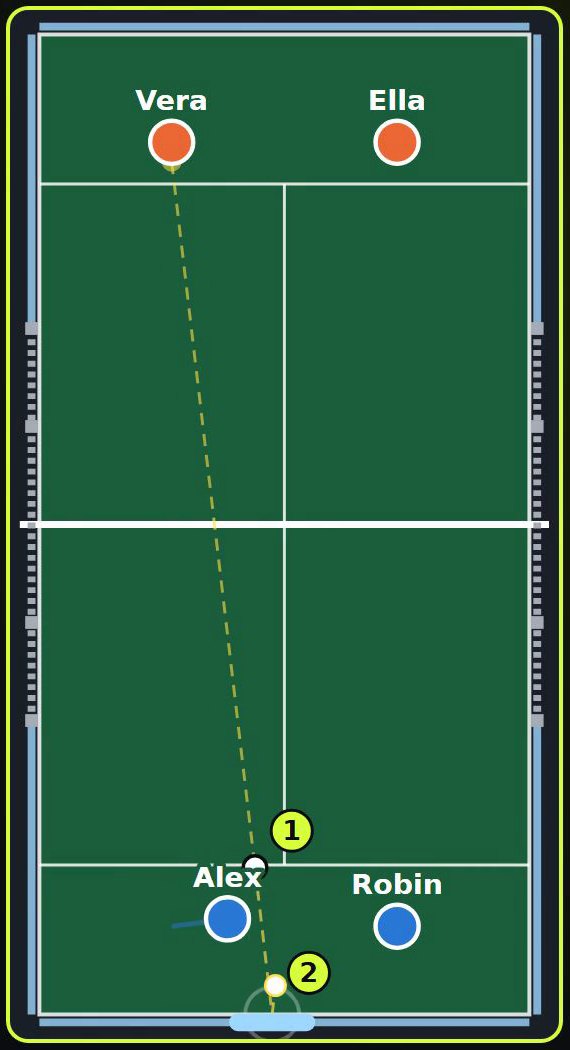
Padel is a racket sport played two against two on an enclosed court. The court is 20 m long and 10 m wide, split by a net, with a 3 m glass wall and 1 m of metal fence at each end and glass and fence along the sides. The ball must bounce on the other side first; after that it may come off the walls, and the other pair returns it before it bounces twice. Padel is not the same sport as pickleball or American paddle tennis.
The rules in full, with drawings: padel rules for beginners. How it compares with the two sports people mix it up with: padel vs tennis vs pickleball.
Where and when was padel invented?
Padel was invented in 1969 in Acapulco, Mexico, by Enrique Corcuera, who put walls around a small court at his home. Alfonso de Hohenlohe built the first two courts in Spain at the Marbella Club in 1974, and from there the sport spread through Spain and Argentina. The International Padel Federation (FIP) was founded in Madrid on 12 July 1991 by the federations of Argentina, Spain and Uruguay.
Why is padel so popular?
Padel is quick to start: the underarm serve, the short racket and the walls keep the ball in play, so beginners get real rallies early. It is played in pairs, so a game is four friends on one court, and a court takes less space than a tennis court. The FIP World Padel Report 2026 counts more than 40 million players in 191 countries and territories, up from 30 million in its 2024 report.
The player counts are FIP’s own figures, gathered from its member federations.
Is padel an Olympic sport?
No, not yet. Padel is not on the programme of the Los Angeles 2028 Olympic Games, and the programme for Brisbane 2032 is due to be set in 2027. Padel was played at the 2023 European Games in Kraków and is on the programme of the 2027 European Games in Istanbul, and FIP keeps campaigning for a place at the Olympics.
As of November 2026.
Can you play padel singles?
Yes, but padel is a doubles sport: the FIP rules describe only the game for four, and the official tours and championships are all doubles. For one against one, some clubs have narrower singles courts, usually 20 m long and 6 m wide, and on a normal court two players often play only cross-court, each covering one diagonal half.
Singles on a full 10 m wide court is hard work: there is twice the court per player to cover, and a ball angled off the side glass is hard to reach. Cross-court singles is a good drill for the bandeja, the volley and playing the back glass.
What do I need for my first padel game?
A racket, a tube of padel balls, sports shoes and three other players. Many clubs rent rackets, so you can try padel before you buy one. Courts are booked for an hour or an hour and a half, usually for four players.
When you buy: how to choose a padel racket, and the current rackets compared. What to learn first: padel tips for beginners.
Are padel balls the same as tennis balls?
No, though they look alike. A padel ball is slightly smaller, 6.35–6.77 cm across against a tennis ball’s 6.54–6.86 cm, and the padel rules set a lower internal pressure. Both weigh 56.0–59.4 g and bounce to about the same height in the official drop test. Play padel with balls sold as padel balls.
| Padel ball (FIP) | Tennis ball (ITF) | |
|---|---|---|
| Diameter | 6.35–6.77 cm | 6.54–6.86 cm |
| Weight | 56.0–59.4 g | 56.0–59.4 g |
| Bounce, dropped from 2.54 m | 135–145 cm | 135–147 cm |
| Internal pressure | 4.6–5.2 kg per square inch, about 10–11.5 psi | no figure set |
The tennis figures are for the standard (type 2) ball. The ITF sets no pressure for tennis balls, and pressureless tennis balls are allowed, so the often-quoted “14 psi” is a typical value, not a rule.
Do you need special shoes for padel?
For your first games, any sports shoes with a flat, grippy sole will do. If you keep playing, get padel shoes or clay-court tennis shoes: their sole is lower and more stable for moving sideways, and the herringbone tread grips the sanded artificial grass most courts have. Running shoes are the poor choice, because their high, soft heel is made for running forward and gives little support when you stop and turn.
Most courts are artificial grass with sand brushed in; the rules also allow cement and other synthetic surfaces. Courts with little sand grip well enough that the sole matters less there.
Try it
Film your first matches and watch them back in Padelapu: see where you stood, what the walls did, and send your partner the moment. Free, no card needed.
Sources
- FIP Rules of Padel, review of application 01.01.2026: The Court (dimensions, walls and fence, surface), The Padel Racket (wrist cord, point 9), The Padel Ball (size, weight, rebound, pressure), Rule 6 (the serve).
- ITF, Rules of Tennis, Appendix I (the ball) (itftennis.com).
- LTA Padel, “History of padel” and “Padel FAQs” (ltapadel.org.uk).
- FIP, Statutes (founding, 12 July 1991) and World Padel Report 2026, October 2026 (padelfip.com).
- IOC, “Event and sports programme decisions made for LA28 and Brisbane 2032” (olympics.com); FIP press, European Games Kraków 2023.
- ASICS, padel shoe advice, 8 July 2021 (asics.com).