Padel rules for beginners
Updated 17 November 2026
Padel is played two against two on a court closed in by glass walls and a metal fence. You serve underarm, after a bounce, diagonally into the box across the net. Every shot must cross the net and bounce on the floor of the other side first; after that bounce the ball may come off the walls, and the other pair plays it before it bounces a second time. Scoring is tennis scoring: 15, 30, 40, game, six games for a set, two sets for the match.
What does a padel tennis court look like?
The court is 10 m wide and 20 m long, split in half by a net 0.88 m high in the middle and 0.92 m at the posts. On each side, 6.95 m from the net, runs the service line, and a centre line splits the area between them into two service boxes.
The court is closed in all round. Each end is a 3 m wall, usually glass, with 1 m of metal fence on top. The side walls are glass for the first metres from each end, and metal fence the rest of the way. The walls are part of the game; the lines matter only when you serve.
Padel serving rules
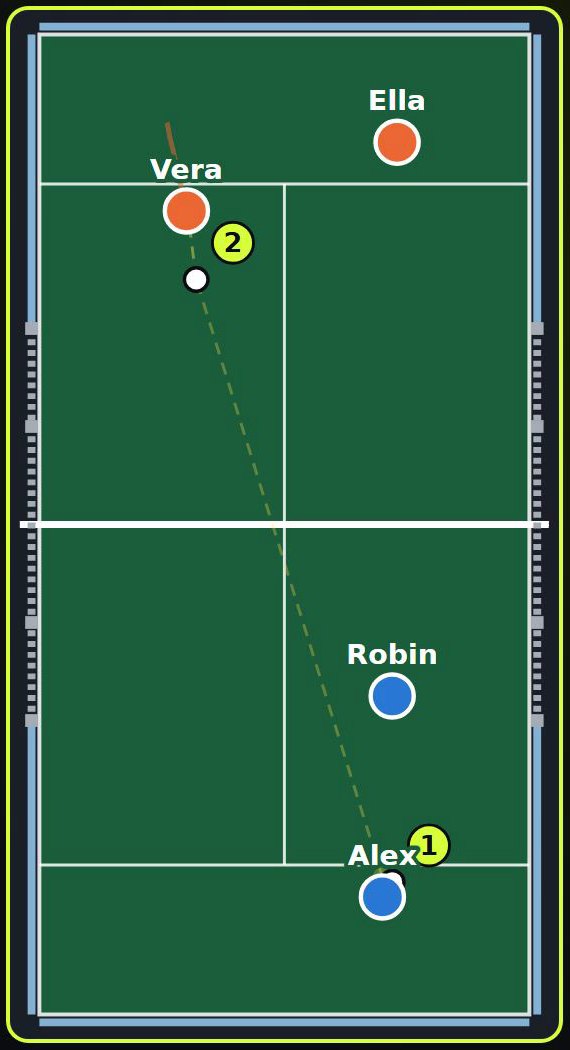
Every point starts with a serve, and you have two serves to get one in. These are the serving rules, each with its rule number in the FIP Rules of Padel.
- Underhand serve. Hit the ball at or below the waist, with at least one foot on the ground (rule 6.4).
- The bounce behind the service line. Stand behind the service line, between the centre line and the side wall, without touching either line with your feet, and stay there until you have hit the ball (rules 6.1 and 6.3). Bounce the ball on the floor of that box, behind the service line, before you hit it (rule 6.2).
- Diagonally into the box. The ball goes diagonally over the net and must bounce in the receiver's service box. The first point of each game is served from the right-hand side, then you switch sides after every point (rule 6.5). A ball on the line is in (rule 7.1c).
- The let. A serve that touches the net or a net post and then lands in the box is served again, as long as it does not touch the metal fence before its second bounce. On a first serve you still have two serves; on a second serve you repeat only the second serve (rules 9.1 and 9.2). A serve made before the receiver is ready is also served again (rules 6.10 and 9.2).
- The receiver lets it bounce. The receiver must let the serve bounce in the box and hit it before its second bounce (rule 8.1). A serve that hits either receiving player or their racket before it bounces is the server's point (rule 8.5).
- Serve faults. The serve is a fault (rule 7.1) if:
- you break one of the serve rules above (7.1a);
- you miss the ball (7.1b);
- the ball bounces outside the receiver's box (7.1c);
- the ball hits you or your partner (7.1d);
- the ball bounces in the box and then touches the metal fence before its second bounce (7.1e). The glass is fine;
- the ball bounces in the box and goes out through a court door, on a court where play outside the court is not allowed (7.1f).
Each player serves a whole game, and the four players take turns in a serving order fixed for the set (rule 6.8). More situations: padel serve rules.
How does scoring work in padel?
Points go 15, 30, 40, game. When both pairs reach 40, it is deuce, and the FIP rules allow three ways to finish the game. Agree on one before you start.
| At 40–40 | How the game ends |
|---|---|
| Advantage | Win the next point for advantage, then one more for the game. Lose it and you are back at deuce, as in tennis. |
| Golden point | One deciding point at the first deuce. The receiving pair chooses which of them receives it. |
| Star point | Two rounds of advantage; at the third deuce, one deciding point, received as in the golden point. |
The first pair to six games with a two-game lead wins the set. At 5–5 you play on to 7–5; at 6–6 you play a tie-break to 7 points. The match is the best of three sets; many tournaments and clubs replace the third set with a super tie-break to 10. You change ends after the first game and then after every second game (games 1, 3, 5…). More: star point, golden point or advantage.
What can the ball hit, and when?
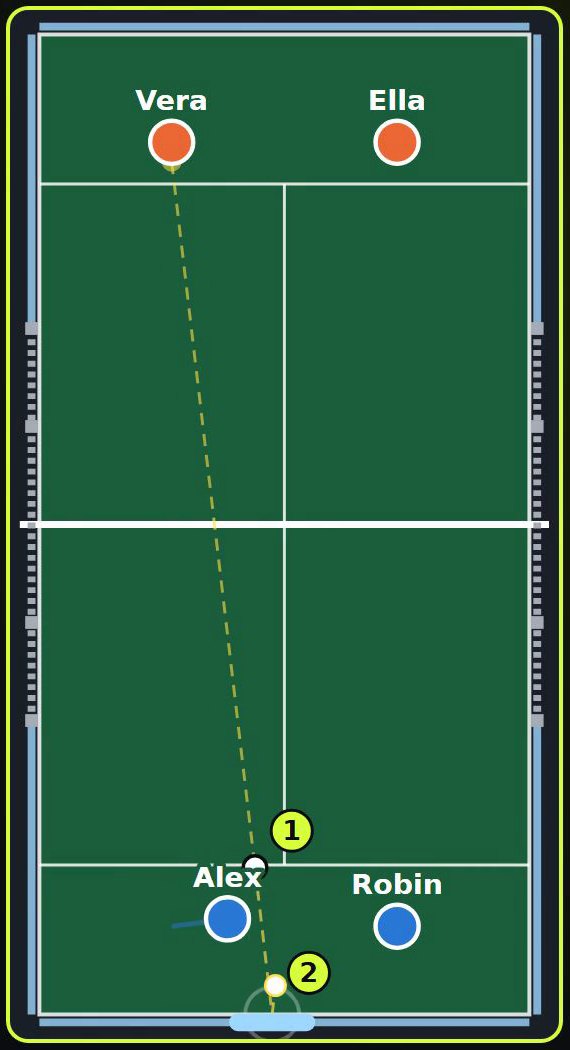
- Floor first, then anything. Once the ball has bounced on your side, it may come off your glass or your fence, and you play it before it bounces a second time.
- Their glass or fence first is out. Your shot must bounce on their floor before it touches their walls. If it hits their glass or fence first, you lose the point.
- Your own glass, yes; your own fence, never. You may play the ball against your own glass so that it goes over the net. If your shot hits your own fence, you lose the point.
- Volleys are allowed, except on the return of serve, which must bounce first.
- The net is fine in a rally: a ball that clips the net and lands on their side is good.
- Out of the court: a ball that bounces on their side and leaves the court is your point, unless the club allows play outside the court and they run out and play it back.
- No lines in a rally. Only the floor and the walls count.
More situations, each drawn from above: can you play the ball off the fence? and in or out in padel.
Which faults do beginners make most?
- Hitting the opponents' glass on the full. Hard shots from tennis go into the back glass before they bounce: your point lost.
- Letting it bounce twice while waiting for the ball to come off the glass.
- Playing into your own fence when a ball off your glass is hit back in a panic.
- Volleying the return of serve. Let the serve bounce.
- Serving too high or on the line. Hit at or below the waist, and keep your feet off the lines.
- Touching the net with your body or racket while the ball is in play, or reaching over it to hit a ball still on their side.
- Both partners hitting the ball, or one of you hitting it twice. Only one player per pair may touch the ball each time.
- The ball touching you or your partner. That is your point lost, even if it was flying out.
- Dropping the racket. Wear the wrist cord; a dropped racket or a broken cord loses the point.
Where can I read more?
- Can you play the ball off the fence in padel?
- In or out in padel? The glass, the lines and out of the court
- Padel serve rules: where to stand, the height, the fence and the net
- Star point, golden point or advantage? Padel scoring
- Padel rules and rule changes
Watch your points back
Film a match and rewatch it with zoom and slow motion, to see which faults cost you points. Free in Padelapu, no card needed.
Sources
- FIP Rules of Padel, review of application 01.01.2026: The Court (dimensions, net, enclosures), Rule 1 (scoring: advantage, star point, golden point, tie-break and the alternative score methods), Rule 5.1 (changing ends), Rules 6 to 9 (the serve, serve faults, the return of serve and the net serve), Rule 12 (ball in play), Rule 13.1 (point lost: a, c, f, g, i, j, k, l, o, q, r), Rule 14.1 (correct return: a, b, e), Rule 16 (out-of-court play).
- The racket's wrist cord is obligatory: FIP Rules of Padel, The Padel Racket, point 9.
More guides
- What is padel? Beginner questions answeredWhere padel comes from, singles, the Olympics, balls and shoes.
- Padel vs tennis vs pickleball: the differencesCourt, walls, racket, ball, serve and scoring side by side.
- Padel tie-break rulesFirst to 7, two clear: who serves, and when to change ends.
- Padel serve tipsWhere to serve once you know the rules.
- Padel tips for tennis playersThree tennis habits that cost padel points.