Your partner turned their back? Tell them where the opponents are
Updated 13 November 2026
When a lob goes over your partner, they run to the back glass with their back to the net. They can’t see what the opponents do next, and that decides their shot. You can see it. Call it while they run: “Both up!” (the opponents rushed the net: lob them), “Both back!” (they stayed back: drive or come in), “One up!” (play away from the net player).
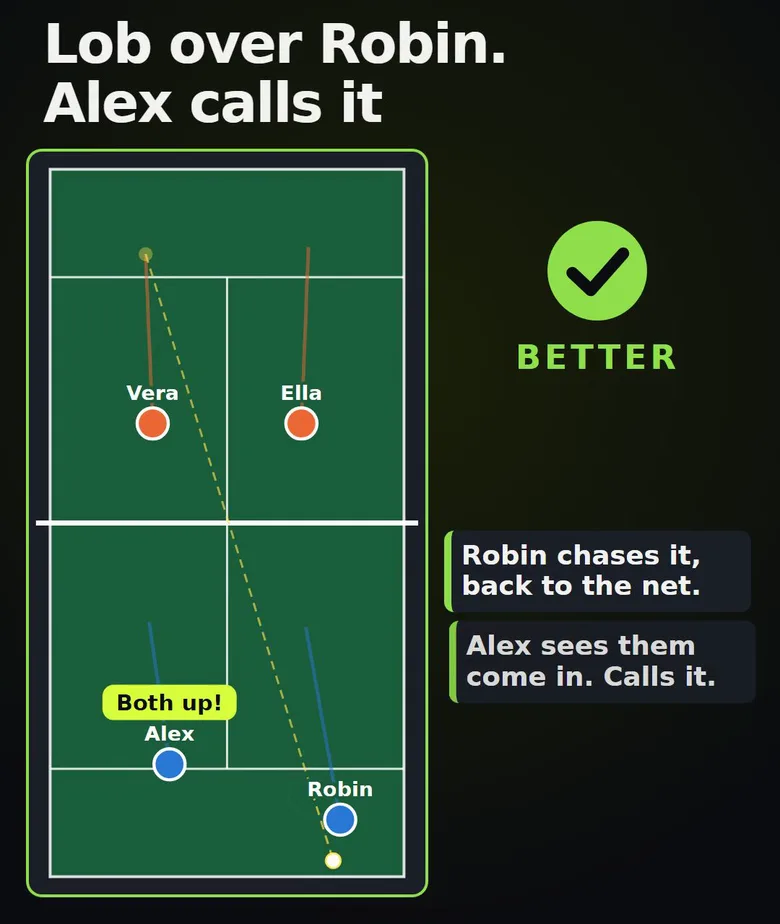
The picture is from our short video on this call; the same play is shown first without a word, then with it.
Why it matters
The lob over the net player is the most common way to take the net in padel. As soon as it goes up, the pair that lobbed often runs forward to steal the net. Your partner, chasing the ball to the back glass, sees only the glass and the ball. When they turn to hit, they have a split second to guess where the opponents are. If they guess wrong:
- They drive the ball low through the middle, and the opponents, already at the net, volley it away.
- They lob, but the opponents stayed back, and the easy chance to come in is lost.
What to say
| You see | You call | Your partner plays |
|---|---|---|
| Both opponents at the net | “Both up!” | A lob over them, high and deep |
| Both still at the back | “Both back!” | A drive or a chiquita, then you both move up |
| One up, one back | “One up!” or “Vera up!” | Away from the net player, or a lob over them |
| The opponents switched sides | “Switched!” | The same shot, the other target |
Use names if you know them. “Vera up!” is quicker to act on than “the one on the left”.
When to say it
Say it once, while your partner is running, before they turn to hit. If the opponents move again, call the change. Keep watching the opponents, not the ball: that is your job in this point. Your partner has the ball.
What you do meanwhile
- Move back with your partner. When one of you is lobbed, the pair usually goes back together, or you switch sides (“Switch!”) if the lob crossed over to you.
- Stand half turned, where you can see both opponents and the ball, not facing the back glass with your partner.
Sources
- Common coaching advice for doubles; the overview lists the sources on calls. No study has measured it.
- International Padel Federation, Rules of Padel, Rule 11 (interference): time your call so it doesn’t land on the opponents’ shot.
Hear it on your own video
Film a match, tag the points you lost down the middle or off a lob, and send your partner the exact moment. Free in Padelapu, no card needed.