Padel communication: what to say to your partner, and when
Updated 13 November 2026
In padel doubles your partner is often looking the wrong way: at the back glass, at a lob, at their own feet. You see what they can’t. Say it, short and early: where the opponents are, whether a ball might fly out, who takes the middle and the shot the other pair keeps playing. Between points, agree one thing for the next point. Short words said before the ball arrives beat long sentences said after.
Why talking wins points
Padel is played as a pair on a small court. Most points at club level are lost on errors and on balls that both of you leave or both go for, not on winners. Nearly every one of those is a moment when one of you knew something the other didn’t:
- You saw the opponents run to the net. Your partner, chasing a lob, didn’t.
- You saw the ball flying long. Your partner was about to volley it.
- You both saw the ball down the middle. Neither of you said whose it was.
A word turns two players into one team. Coaches teach the same handful of calls for that reason: they are short, they mean one thing, and both of you know them before the match.
The six habits
- Tell your partner where the opponents are when they turn their back to chase a ball. “Both up!” means lob. “Both back!” means you can come in.
- Warn when the ball might go out. A hard ball flying long or wide is often going straight into the glass or the fence. If nobody touches it, it’s your point.
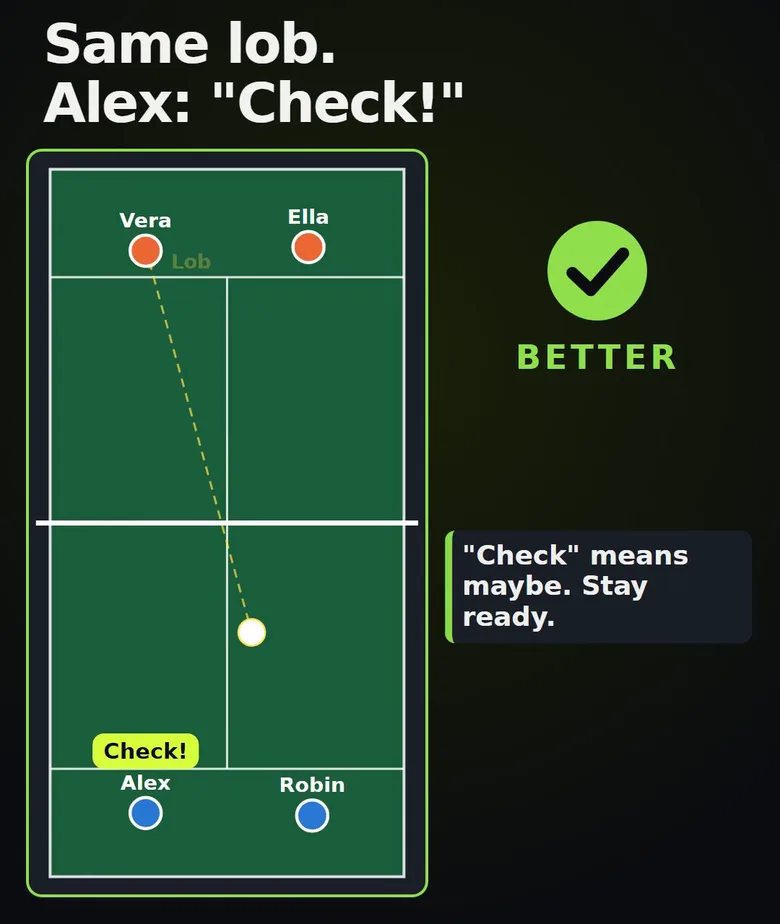
- Say “check”, not “out”. “Out” sounds like a decision; when the ball dips in, your partner has already given up on it. “Check” means maybe, be ready.
- Call the middle ball, and call it early: when the opponent hits, not when the ball arrives.
- Talk tactics between points. Three seconds, one thing: the plan, what’s working, where they’re weak.
- Warn about their favourite shot. “Protect your corner!” before the víbora they have already hit into it five times.
The calls, on one card
| Call | Who says it | It means |
|---|---|---|
| “Mine!” | The one taking the ball | I’ve got it. You cover the rest. |
| “Yours!” | The one leaving it | Yours, and I’m moving to cover. |
| “Switch!” | The one crossing behind | We swap sides (after a lob over one of you). |
| “Both up!” “Both back!” “One up!” | The one who can see them | Where the opponents are right now. |
| “Check!” | The one not hitting | It might fly out. Be ready to leave it. |
| “Leave it!” | The one not hitting | It’s going straight into the glass. Don’t touch it. |
| “Your corner!” | Either | Their favourite shot is coming to you. |
| “Up!” “Back!” | Either | We move to the net, or back, together. |
Agree your words before the first game. Any word works if both of you know it. Spanish works on any court in the world: mía (mine), tuya (yours), cambio (switch).
Four rules for every call
- Short. One or two words. The ball won’t wait for a sentence.
- Early. As the opponent hits, not as the ball reaches you.
- Loud enough, never at them. Talk to your partner, not over the opponents’ shot.
- Then do what you said. A “Mine!” is a promise. If you call it, play it.
Sources
- International Padel Federation, Rules of Padel, review of application 1 January 2026: Rule 11 (interference) and the rule on losing the point.
- PadelPoint, Effective verbal signals in padel: the common calls.
- The Padel School, Padel doubles strategy.
- The calls table and the four rules are common coaching advice, put together by us; no study has tested which words work best.
Hear it on your own video
Film a match, tag the points you lost down the middle or off a lob, and send your partner the exact moment. Free in Padelapu, no card needed.
More guides
- Padel Americano and MexicanoA new partner every round: how the formats work.
- Tell them where the opponents are“Both up!” when your partner chases a lob.
- When the ball might go outA ball into your glass before it bounces is your point.
- Say “check”, not “out”Why “out” makes your partner stop too early.
- Call the middle ball earlyCall it when they hit, not when it lands.
- Talk tactics between pointsThree seconds, one thing, not the last mistake.
- “Protect your corner!”Warn about the shot they keep playing.