The ball down the middle: call it when they hit, not when it lands
Updated 13 November 2026
Agree before the match who takes the middle ball: usually the player with the forehand in the middle (for two right-handers, the one on the left). Then call it the moment the opponent hits: “Mine!”. Called when the ball is already between you, it’s too late: both of you have started, or both have stopped.
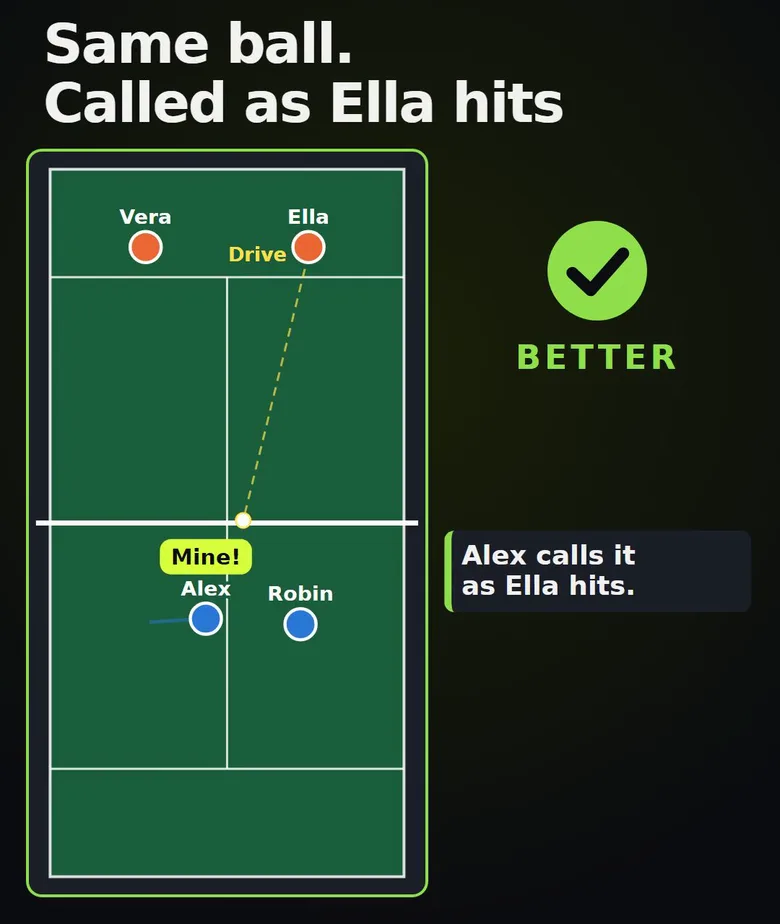
The picture is from our short video on this call; the same play is shown first without a word, then with it.
Why the middle is lost
The middle is the shortest way between the opponents and your court, and it’s where two rackets meet. Two things go wrong:
- Both leave it. Each thinks the other has it. “Yours!” “No, yours!”
- Both go for it. Two rackets, one ball, and both sides of the court left open.
Either way nobody decided in time.
Who takes it
Agree a default before the first game, so the call only confirms it:
- The forehand in the middle takes it. For two right-handers, that is the left-side player. With a left-hander on the right, both forehands meet in the middle, so agree who.
- Unless the other one is clearly better placed: closer to the net, or the ball is coming diagonally towards them. Then they call it.
- A ball for an overhead goes to whoever has it on the forehand side, usually the stronger overhead in the pair.
When to call
When the opponent’s racket meets the ball. You know the direction then. Waiting until it crosses the net costs half a second, and half a second at the net is a whole step. The other player answers with a move, not a word: they cover the space the caller leaves.
“Mine!” is a promise
If you call it, play it. A call followed by a step back is worse than no call. If you change your mind, say “Yours!” at once, not after the ball has passed.
Sources
- Common coaching advice; the overview lists the sources on calls. Who takes it is the usual club rule, not a rule of the game.
- International Padel Federation, Rules of Padel: only one player of a pair may play the ball, and both hitting it loses the point.
Hear it on your own video
Film a match, tag the points you lost down the middle or off a lob, and send your partner the exact moment. Free in Padelapu, no card needed.
More guides
- Padel communication: all six callsAll six calls on one card, and four rules for any call.
- Tell them where the opponents are“Both up!” when your partner chases a lob.
- Talk tactics between pointsThree seconds, one thing, not the last mistake.
- Padel net positioningWhere to stand at the net, and moving as a pair.