Common padel injuries and their early signs
Updated 16 November 2026
- If something hurts and does not settle, or you notice one of the signs below, stop playing and ask a doctor or physiotherapist what to do. How to treat an injury is for them to decide with you.
- The contact routes named here (GP, NHS 111, A&E) are the UK's; use your own country's doctor, urgent-care line and emergency number.
Most padel injuries build up over time rather than happen in one moment, and most hit the elbow or the lower leg: the calf, the Achilles tendon and the ankle. Knowing the early signs helps you stop in time and get a professional's advice before a small problem becomes a long one.
How often padel players get hurt
The one systematic review of padel injuries, eight studies and 2,022 players, found about 3 injuries per 1,000 hours of training and 8 per 1,000 matches. Between 40% and 95% of players reported an injury, depending on the study (Dahmen and others, 2023). Surveys of recreational players since then land at about 3 to 4 injuries per 1,000 hours of play (Belgium, Portugal). All of these figures come from players' own reports, so they are rough.
Where it hurts
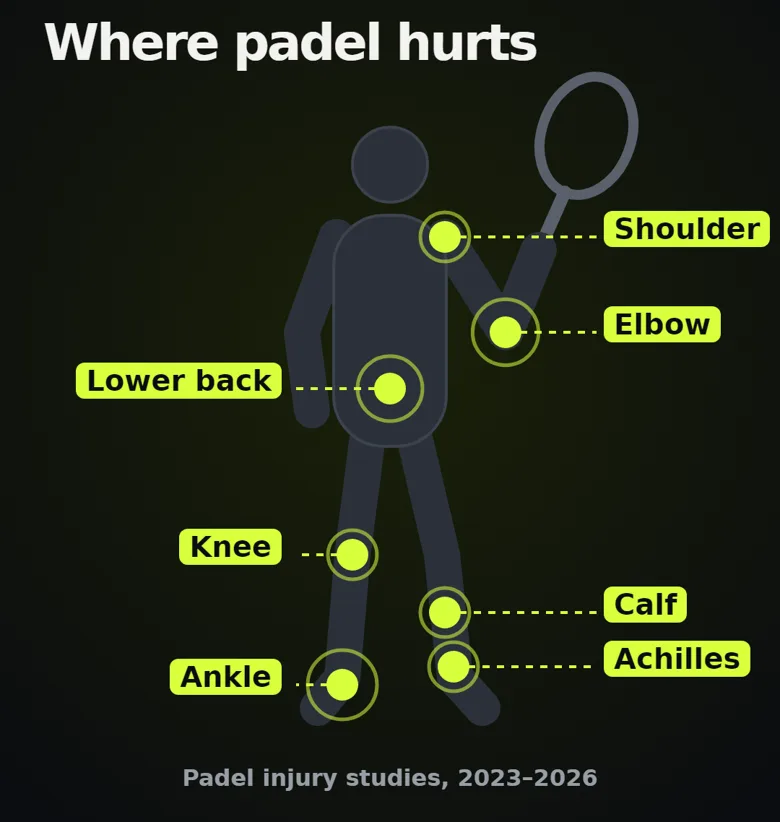
Studies disagree on which comes first, but two areas lead in nearly all of them: the elbow, and the lower leg. The shoulder, knee and lower back follow.
The six to know
For each one: the early signs, and when the NHS says to get help. For how to treat it, ask a doctor or physiotherapist.
1. Padel elbow
Early signs: pain on the outside of the elbow when you grip, lift or twist the forearm, for example turning a door handle. Doctors call it tennis elbow (NHS, tennis elbow).
Get it checked: the NHS says to see a GP if you still have elbow pain after at least two weeks of rest (NHS, tennis elbow).
2. The calf tear
Early signs: a sudden sharp pain in the calf, often described as being kicked or struck from behind (StatPearls). It is seen most in men over 40 (Aspetar, 2023). Stop playing.
Get it checked: the NHS says to get urgent advice if the leg is very painful, or you cannot put weight on it or walk more than a few steps (NHS, sprains and strains). Throbbing pain and swelling in one leg, with warm, red or darkened skin, can be a blood clot (DVT) and not a muscle injury: the NHS says to get medical help as soon as possible, and to call emergency services if you also have chest pain or are short of breath (NHS, DVT). Do not try to tell the two apart yourself.
3. The Achilles tendon
Early signs: pain in the tendon above the heel that gets worse when you move, stiffness, and sometimes swelling (NHS, tendonitis).
Get it checked: sudden, severe pain during play, perhaps with a pop or snap, may mean a torn tendon: the NHS says to get urgent help (in the UK, NHS 111). See a GP if tendon pain does not improve within a few weeks (NHS, tendonitis).
4. The ankle sprain
Early signs: pain, tenderness or weakness around the ankle, swelling or bruising, and finding it hard to put weight on it (NHS, sprains and strains).
Get it checked: the NHS says to go to emergency care if you heard a crack, the ankle has changed shape, or it is numb, tingling, discoloured or cold. Get urgent advice if it is very painful or getting worse, or you cannot put weight on it or walk more than a few steps (NHS, sprains and strains).
5. The shoulder
Early signs: shoulder pain that is often worse while you use the arm, as in overhead after overhead (NHS, shoulder pain).
Get it checked: the NHS says to see a GP if shoulder pain is getting worse or has not improved after two weeks, and to get urgent advice for sudden or very bad pain, pain after a fall or injury, an arm you cannot move, a shoulder that has changed shape, or pins and needles that do not go away (NHS, shoulder pain).
6. The lower back and the knee
Early signs in the knee: pain after overstretching, overusing or twisting it, pain between the kneecap and the shin after a lot of running or jumping, or a knee that feels unstable and gives way when you stand (NHS, knee pain).
Get it checked: for the knee, the NHS says to get urgent advice if it is very painful, badly swollen or has changed shape, you cannot put weight on it, or it locks or gives way (NHS, knee pain). See a doctor if back pain has not improved after a few weeks or is worse at night. Back pain with pain, tingling, weakness or numbness in both legs, loss of feeling around the genitals or anus, or changes in bladder or bowel control is an emergency (NHS, back pain).
Questions
Should I play through pain?
No. Stop if something hurts, and do not take painkillers to keep playing. If the pain gets worse, keeps coming back or has not settled after a couple of weeks of rest, see a doctor or physiotherapist. For the warning signs listed above, get help at once.
How should I treat it?
Ask a doctor or physiotherapist who has examined you. Treatment and a return to padel depend on what they find, so this page gives neither.
Rewatch your matches
Upload a match and watch it back with zoom and slow motion. Free in Padelapu, no card needed.