Padel video analysis: how to review your own matches
Updated 23 October 2026
Padel video analysis means rewatching your own match to find the one or two habits that cost you the most points. Pick five points you lost, slow each one down, and look at where you and your partner stood when the opponent hit the ball. The pattern you see three times is the thing to change.
You remember your winners. The video remembers everything else: the step you did not take, the lob that fell short, the gap that opened between you and your partner. Twenty minutes with the recording of a match tells you more than the score ever does.
Our short video: positions first, one point you lost, then show it to your coach.
▶ Watch the video: Watching your padel match video? Start with where you stood.
A 20-minute review routine
- Watch one set at normal speed. Do not stop. Note the time of each point you lost that annoyed you.
- Pick five of them. Leave out the opponents' great shots; you cannot fix those. Keep the points you gave away or let them take.
- Loop each point and slow it down. Set a loop around the rally and play it at half or quarter speed until you can say what happened in one sentence.
- Freeze the moment the opponent hits. Step frame by frame to the contact. Where are you both? Facing the ball? Moving or standing?
- Write down one thing. One habit to change in the next match, not five. Check it again on the next recording.
What to look for
Where you stand
Most points in club padel are lost in the space between the service line and the net, the transition zone, sometimes called no-man's-land. A ball at your feet there is hard to play. Freeze the frame when the opponent hits: if you are caught in the middle, the fix is usually to go all the way to the net or stay back, not to stop halfway.
How you move as a pair
Partners in padel move together, forwards and backwards and towards the side the ball is on. On the video, watch the distance between you. A pair that splits, one at the net and one at the back, leaves a diagonal gap that good opponents play into.
Your lobs
A lob that lands short gives the opponents an easy overhead. Watch where your lobs bounce and what came back: an overhead from the net means the lob was too low or too short.
Your overheads
Not every high ball is a smash. Watch what happened after your overheads: did you keep the net, or did you have to run back? A controlled bandeja that keeps your position often wins more points than a smash that comes back off the wall.
Timing
Frame steps show what normal speed hides: whether you were set before the ball arrived, and where you hit it relative to your body. On a 60 fps recording you get twice as many frames around each contact.
The tools that make it quick
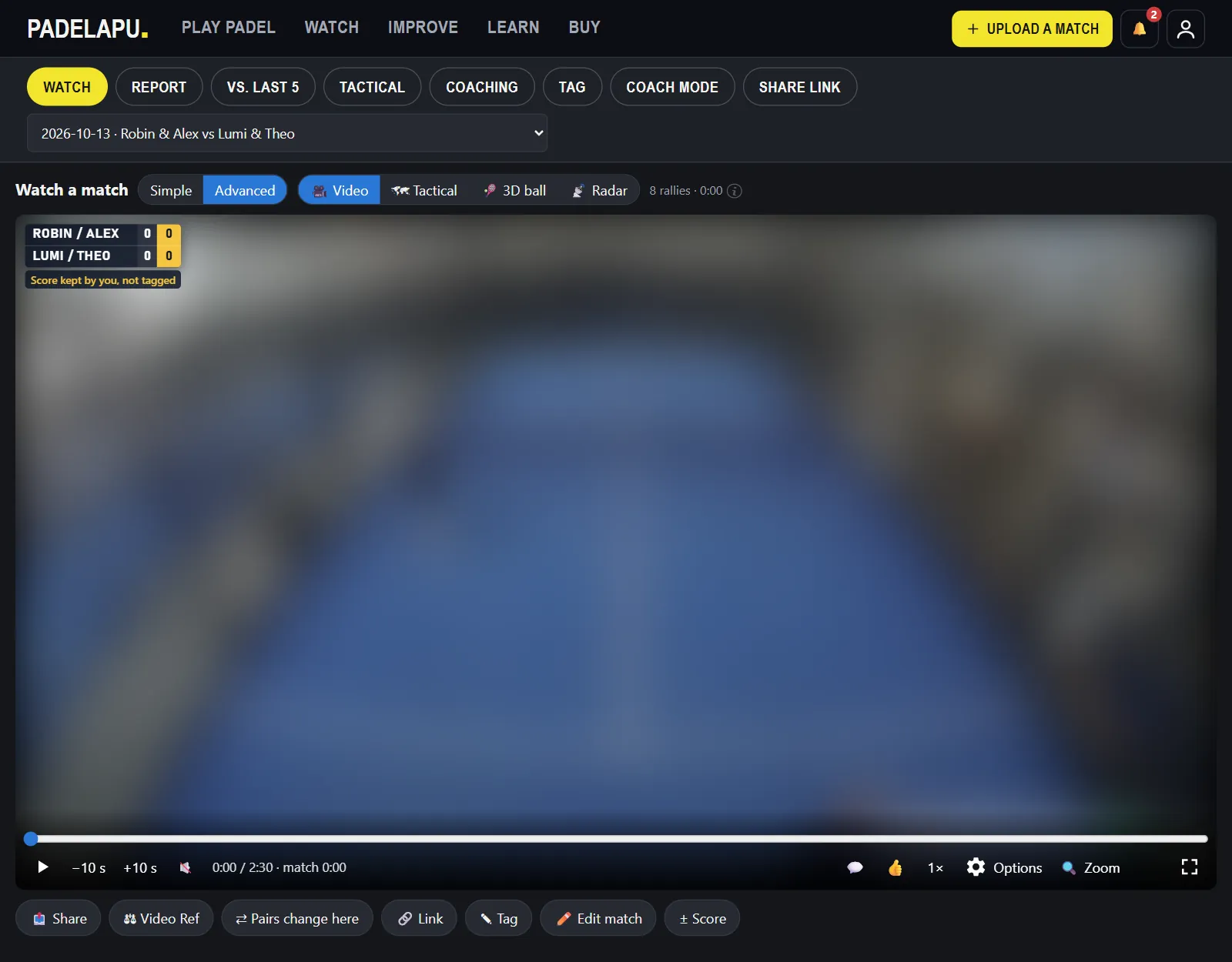
An ordinary video player is made for watching, not for studying. Padelapu's free player is made for the second:
- Zoom. Click the spot to magnify one player, so a far-court player is as clear as a near one.
- Slow motion. Quarter and half speed for the whole rally.
- Frame steps. One frame back or forward, to find the contact.
- A–B loop. Set a start and an end and the moment plays again until you have seen it.
- Clips. Share a loop or the last ten seconds with your partner or coach, straight from your phone's share sheet.
| Key | Does |
|---|---|
| Space | Play or pause |
| ← → | Back or forward 5 seconds |
| [ ] | One frame back or forward |
| , . | Previous or next point, on a tagged or analysed match |
| L | Loop: start, end, then off |
| ? | All the shortcuts |
From watching to numbers
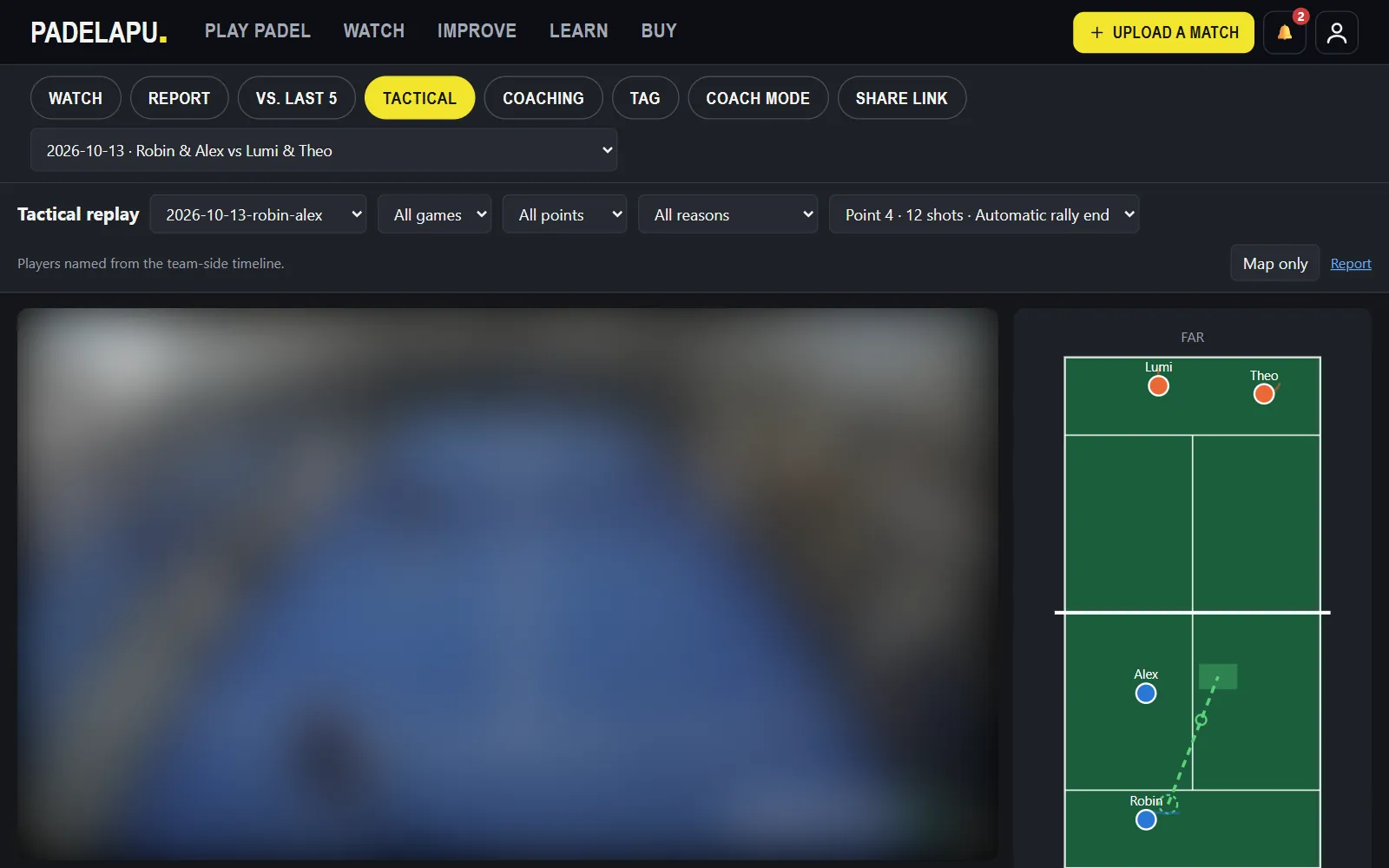
Once you have watched a match, tagging it turns what you saw into statistics: you mark each hit and how each point ended, and Padelapu builds the stats, heatmaps and reports from your tags. That is free.
Padelapu Pro does the first pass for you. It finds the players, follows the ball and splits the match into rallies, so you can skip the breaks and jump point to point. What you tag yourself is shown as tagged.
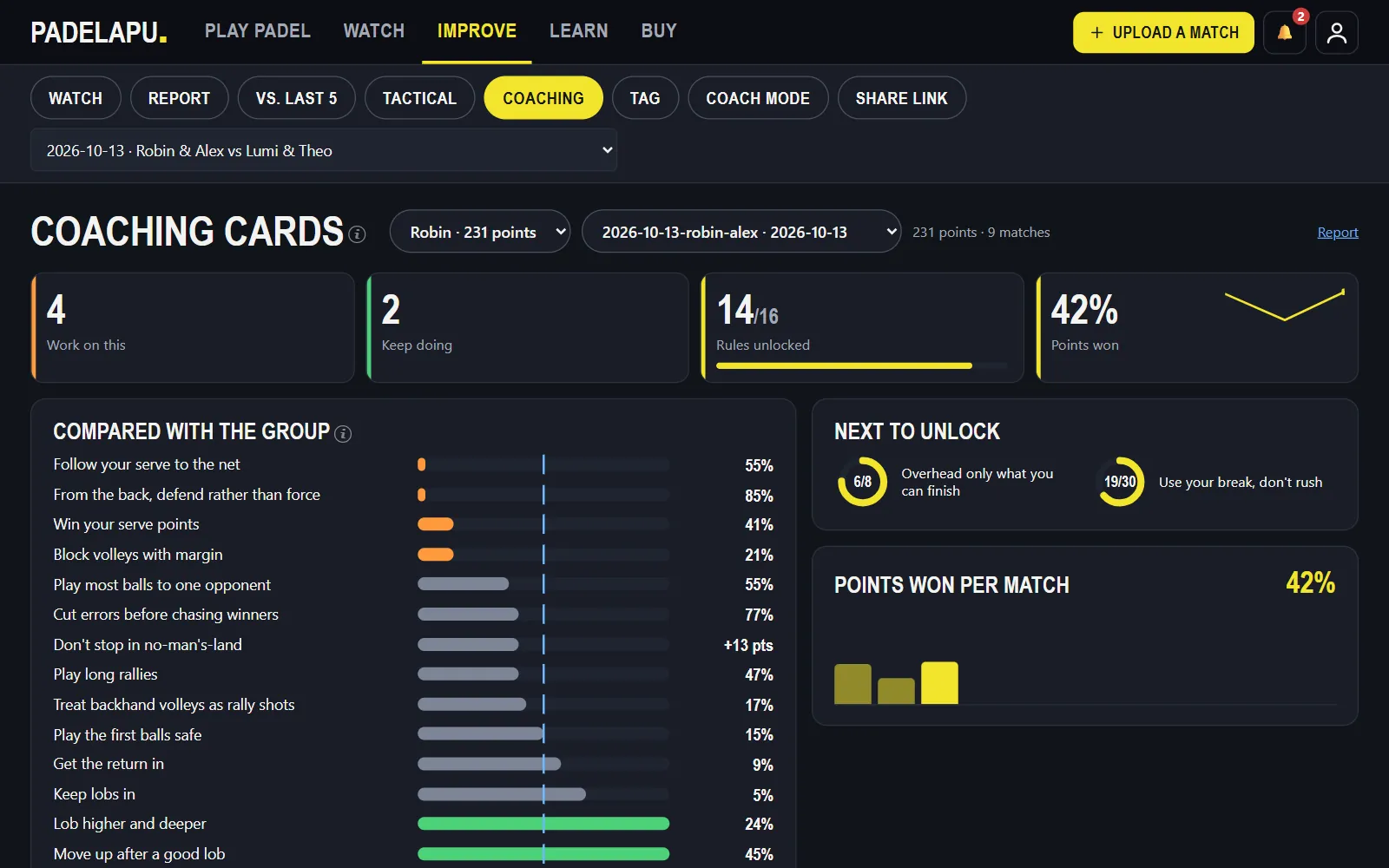
Coaching tips then point at the habits that show up again and again, each with the count it is based on, so you know when a pattern is real and when it is three points.
Questions
How often should I review a match?
One match every week or two is plenty. The point is to check whether the one habit you picked has changed, so the next review has a question to answer.
Should my partner watch too?
Yes. Half of padel happens between partners, and you will each see different things. Share the clip of the point you disagree about.
Do I need the whole match on video?
A set is enough to start. For automatic analysis and a fair picture of your stats, the whole match is better.
Review your next match
The video player, clips and tagging are free. Create an account with your email; no card needed.