Padel training plan 2027: your week by level and how often you play
Updated 11 November 2026
A good padel week has one theme. Drill it, play points with it, then check it on video. As a starting point, beginners spend about two thirds of their court time learning and one third playing; intermediate players turn that round. Whatever your level, add two short strength sessions a week, and when you play more, add one session at a time.
Find your level
Every platform names levels its own way, and no official table converts between them. Playtomic calculates a 0–7 level from your match results. The LTA rating runs from 1.0 to 7.0, and you pick it yourself. These four bands are ours and approximate. The LTA's own labels are stricter: it calls everything up to 5.0 intermediate and keeps "advanced" for nationally ranked players.
| Level | Playtomic | LTA | You can… |
|---|---|---|---|
| Beginner | 0–1.5 | 1.0–2.5 | rally slowly. The back glass is still hard, and you let lobs bounce. |
| Improver | 1.5–2.5 | 2.5–3.5 | rally consistently and defend off one glass. Your bandeja comes and goes, and you get caught halfway to the net. |
| Intermediate | 2.5–4.0 | 3.5–4.5 | play a bandeja, defend off both glasses and move between the back and the net smoothly. You are working on the víbora and the chiquita. |
| Advanced | 4.0–5.5 | 4.5–5.5 | play tournaments with few unforced errors and the full range of shots. |
What to learn, in what order
Coaching courses teach padel in roughly this order (LTA Padel Xpress, Padel Xpress 2.0, The Padel School's beginner pathway). No study has compared teaching orders.
- Grip, ready position and where to stand. Knowing where to be, and moving with your partner, comes before any shot.
- Groundstrokes and the back glass. Points at club level are lost on errors, so consistency comes first.
- Serve, return and volley.
- The lob and the bandeja, together. The lob is how you take the net, and the bandeja is how you keep it.
- Wall defence off both glasses, and the move between the back and the net.
- The víbora, the chiquita and the finishing shots. They pay off once you can hold the net and play a reliable bandeja.
One session, 60 or 90 minutes
| Block | 60 min | 90 min |
|---|---|---|
| Warm-up, overheads last | 10 | 15 |
| Your theme, the same ball again and again | 10 | 15 |
| Your theme, mixed feeds and choices (lob or low? bandeja or smash?) | 15 | 20 |
| A game where every point starts with your theme | 15 | 25 |
| Free points | 10 | 15 |
Warm up for 10–15 minutes before you hit hard: raise your pulse, move your shoulders and hips, start with short rallies and volleys, and leave overheads until you are warm (Padel New Zealand).
Repeating the same ball helps while you learn a shot; mixing it with other balls tends to make it last and carry into matches. The effect is clear in lab studies and smaller on real courts (a 2024 meta-analysis). Practice spread across the week also sticks better than one long block (Donovan and Radosevich, 1999). Keep one theme per fortnight: write it down, then look for it in your next match video.
Your week
Pick how many times a week you play. S is a 20–40 minute strength and mobility session off court.
Once a week
| Level | Your week |
|---|---|
| Beginner | A group lesson that ends with real points. 2 × S |
| Improver | A lesson or drill session one week, a match the next. 2 × S |
| Intermediate | A match; use the first 20 minutes of the booking to drill your theme. Rewatch one match a month. 2 × S |
| Advanced | A competitive match, reviewed on video to pick next month's theme. 2 × S |
Once a week mostly keeps your level where it is. A plan gets more out of that one session.
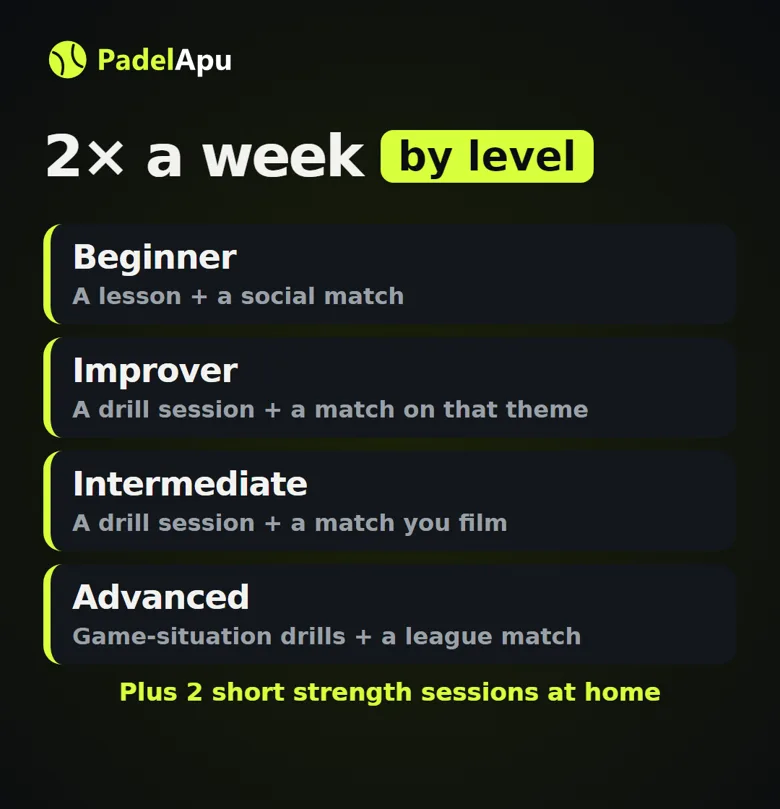
Twice a week
| Level | Session 1 | Session 2 |
|---|---|---|
| Beginner | Lesson or clinic | Social match, or drills and points with friends |
| Improver | Drills on your theme | A match, playing your theme |
| Intermediate | Drills or a lesson | A competitive match, filmed |
| Advanced | Game-situation drills at high intensity | League match |
Plus 2 × S.
Three times a week
| Level | 1 | 2 | 3 |
|---|---|---|---|
| Beginner | Lesson | Drills and themed games | Social match |
| Improver | Lesson or drills on your theme | Themed games | Match |
| Intermediate | Drills on your theme | Match | Match, filmed |
| Advanced | Game-situation drills | Competitive match | Match or a second drill session |
Plus 2 × S. Keep one full rest day, and don't play hard three days in a row.
Four or more times a week
| Level | Your week |
|---|---|
| Beginner | Don't start here. Build up from two sessions over several weeks. |
| Improver | 1 lesson, 1–2 drill sessions, 2 matches. An easy day between hard ones. |
| Intermediate | 2 drill sessions, 2 matches (film one). |
| Advanced | 2 drill sessions, 2–3 matches or a tournament. Ease off before your main event. |
Plus 2 × S, and mobility on rest days.
Adding sessions: add one a week and hold it for two or three weeks before adding another. Sudden jumps in how much you play are linked with more injuries, while players who build up gradually tolerate high amounts well (Gabbett 2016). The research comes from team sports and its exact ratios are disputed, so take "two or three weeks" as a sensible rule, not a measured one. Pain that lasts into the next day, or a sore elbow or shoulder, means step back a session.
Your 2027, in four blocks
| Block | On court | Off court |
|---|---|---|
| Jan–Mar Foundation | Consistency, glass defence, serve and return. Build up slowly after the holidays. | Strength 2× a week |
| Apr–Jun Build | The net: volleys, the lob and then moving in, the bandeja | Strength 2×, add speed and agility |
| Jul–Sep Compete | More match play: patterns, and talking to your partner | Strength 2×, shorter sessions to keep it |
| Oct–Dec Refine | Fix what your video shows. Add one new shot. | Strength 2×, an easy week or two at Christmas |
Take a light week now and then, roughly every fourth: half the court time and nothing new. Every fourth week is a convenient rule, not a proven one: coaches use light weeks widely, but no research has set the best interval. If your league or main tournament falls elsewhere in the year, shift the blocks so that Compete covers it.
Check your progress every quarter
Film a match at the end of each block, against similar opponents if you can, and compare it with your own last check, not with the pros.
| Check | Where to see it |
|---|---|
| Errors per match: into the net, out, off the glass | Padelapu, from your tags |
| Average rally length (longer means more consistent) | Padelapu |
| Share of your hits that are volleys | Padelapu's shot mix |
| Hits from the transition zone (stuck halfway?) | Padelapu, where you stand |
| How many lobs you play | Padelapu's shot mix |
| First serves in, and where your lobs land | Count them on the video |
| After your overhead: did you keep the net? | Count it on the video |
In professional padel, 40% of unforced errors come in the first four seconds of a rally and most points are won from the net (Courel-Ibáñez and others, 2017, 1,527 rallies from the 2013 World Padel Tour Masters Finals). The checks above follow both. These are figures for top professionals, not targets for club players. Padel stats explained says what each number means.
Questions
How long does it take to move up a level?
Nobody has measured it. One band a season is a fair aim if you play twice a week or more with a plan. Your quarterly video checks will show progress before your rating does.
Do I need a coach?
You can improve without one, but a lesson is the quickest way to learn a new shot and to catch a habit before it sticks. The LTA recommends mixing coaching, drills with a partner and competition. The rest of the week can be drills with friends and match play.
Is padel enough exercise on its own?
For your heart and lungs, regular padel goes a long way towards the 150 minutes of moderate activity a week that the WHO recommends. For strength it is not enough: the WHO guidelines also recommend muscle-strengthening work on at least two days a week for all adults. In trials across several sports, strength training cut injuries to about a third (Lauersen and others, 2014). None of those trials were in padel.
See your progress
Film a match, tag it, and compare it with your last ones. Free in Padelapu, no card needed.
More guides
- Padel Americano and MexicanoSocial formats with a new partner every round.
- Padel stats explainedWinners, errors, rally length, net and back: what the numbers mean.
- How to film a padel matchWhere to put the phone, and which settings.
- Padel communicationWhat to say to your partner, and when.
- Common padel injuries and their early signsThe six injuries club players get most, and when to get help.
- Padel rules for beginnersThe court, the serve, scoring and what the walls allow.
- Padel tips for beginnersWhat to learn first, where to stand and your first drills.
- How to choose a padel racketShape, balance and weight, and the rackets makers rate for beginners.