Padel net positioning: where to stand, how to move as a pair, and the formations
Updated 16 November 2026
At the net, stand about two to three metres from it, well in front of the service line, with your racket up in front of you. Move with your partner as if you were tied by a rope: when the ball goes to one side, you both shift that way, the player on the ball’s side covers the line and the other closes the middle. Go up together, after a lob that pushes the opponents back, and never leave one of you at the net and the other at the back for long.
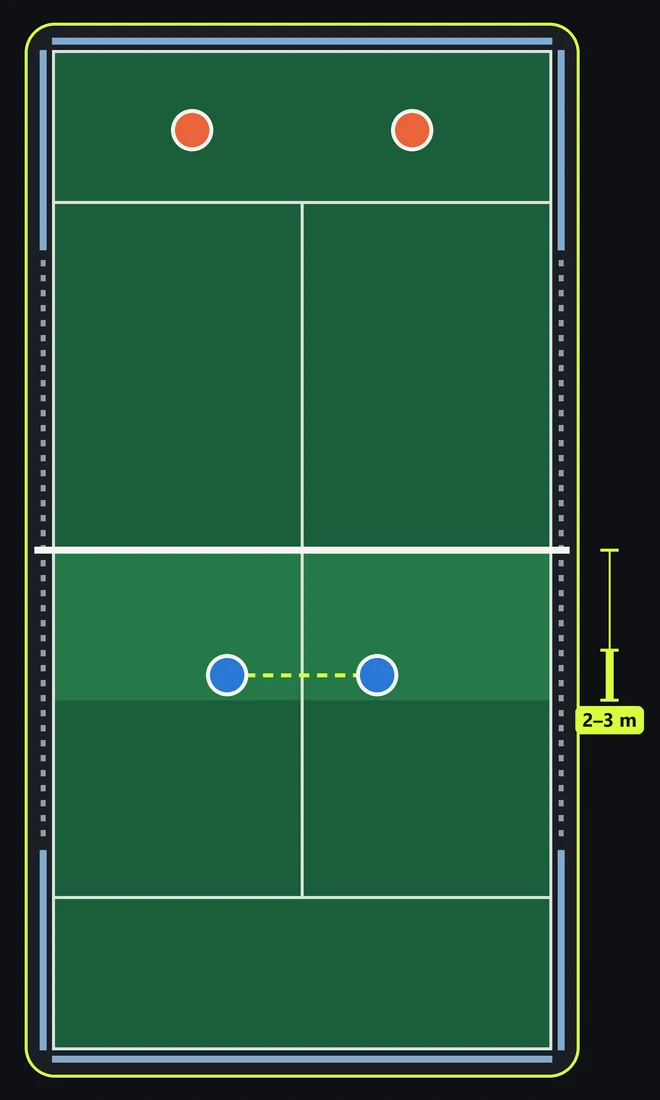
Drawn from above: the near pair (blue) stands side by side about two to three metres from the net, and the dashed line is the rope between them. The lighter band is Babolat’s green zone, the net to about 3 m back. The opponents (orange) are at the back.
How far from the net should you stand?
Most coaches put the net player about two to three metres from the net. The service line is 6.95 m from the net (FIP Rules, The court), so that is a little less than halfway to it. Babolat’s coaching guide calls the area from the net to about three metres back the attacking zone: volleys, bandejas and smashes at the opponents’ feet or into the angles.
- Too close and every lob goes over you. You also risk the net: touching the net or the posts with your body or racket while the ball is in play loses the point (Rule 13.1a), and so does hitting the ball before it has crossed to your side (Rule 13.1f).
- Too far back and the ball comes at your feet, and the opponents get the angles past you.
- It changes with the ball. Step in for a high, slow ball you can put away; take a step back when the opponent is set to lob.
| Zone (Babolat) | Where | What to play |
|---|---|---|
| Green | The net to about 3 m back | Attack: volleys, bandejas, smashes, to the feet or the angles |
| Orange | Between the service line and the back wall | Build the point or attack, depending on how high and fast the ball is |
| Red | About 2 m from the back glass | Stay in the point: high, deep shots such as the lob |
How should you stand at the net?
The LTA’s volley advice: hold the racket at the height you will meet the ball, ideally above the net, so you don’t have to lift it for every shot, and meet the ball out in front of your body, stepping in with the opposite foot. Add the usual coaching basics: knees soft, weight on the front of your feet, and a small hop (a split step) as the opponent hits, so you can push off either way.
Who covers what? The ball-side rule
The court is shared by the ball, not split down the middle line. A common coaching rule:
- The player on the ball’s side covers the line along their side wall, and steps a little closer.
- The partner moves towards the middle and a little back, covering the middle and the lob. The Padel School puts it plainly: when one player is pulled wide, it is the partner who makes the adjustment.
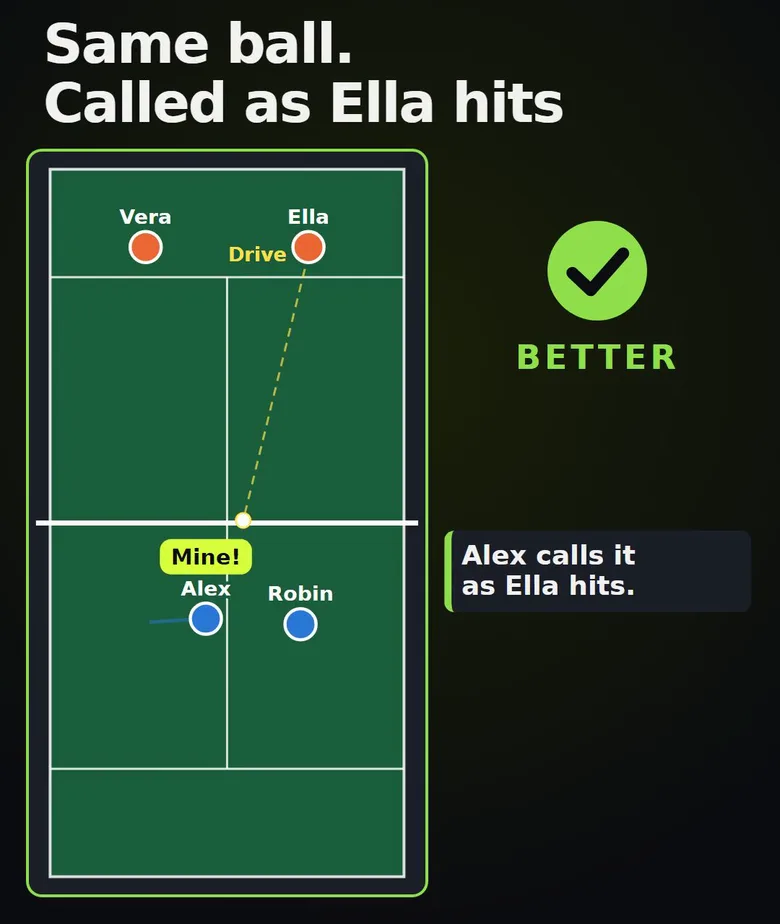
- The ball down the middle goes to the player you agreed on before the match, usually the one with the forehand in the middle. See the middle ball for when to call it.
When the opponents keep hitting the same shot into one corner, warn your partner so they shade that way: protect your corner.
How do you move as a pair?
Think of a rope between you: about the same distance apart all the time.
- Sideways together. The ball goes to the left, you both shift left. If only one moves, the gap opens in the middle.
- Back together. When a lob goes over one of you, the other goes back too. If one stays at the net, The Padel School warns, there is a huge gap on the diagonal.
- Up together. When you win the net back, both come in, not one.
Both at the net, side by side, the same distance from it: the 2-2 at the net. Our short video Move as a pair and close the gap shows the rope on a drawn court.
When should you go to the net?
The LTA calls the net the stronger place to be: you see the whole court and have more shots to choose from, while the back is for defending. Go up when the opponents can’t hurt you on the way in:
- After a good lob that sends both of them back. The LTA notes that the lob is common because it gives both players time to get forward.
- After a low ball at their feet (a chiquita) as they come in, and after your serve: the server follows the serve in (padel serve tips).
- Not after a short, high ball: that is the one they smash. Get the ball deep first (shot selection).
Once you are up, keep the net with your overheads: a bandeja or víbora that keeps you there is often better than a smash that sends the ball back to them. See víbora vs bandeja.
What are the 2-2, 1-3 and Australian formations?
None of these is in the rules: the FIP Rules let every player stand anywhere on their own side, except the server, who serves from behind the service line in their service box (Rule 3.2, Rule 6.1). The names come from coaching, and they are used in slightly different ways. Here is the definition we use for each, and where it comes from.
| Formation | Where the players stand | Definition from |
|---|---|---|
| 2-2 | Both partners side by side, the same distance from the net: both up or both back. The standard formation. | Common coaching use |
| 1-3 | Three players at the net and one at the back. It happens in a rally, for example when the returners come in and the server is still back; nobody sets it up on purpose. | Padel-rules.pages.dev, “Padel formations explained” |
| Australian | On the serve, the server’s partner stands close to the net on the same side as the server, not on the other side. | Ramón-Llin et al., PLoS One 2021 |
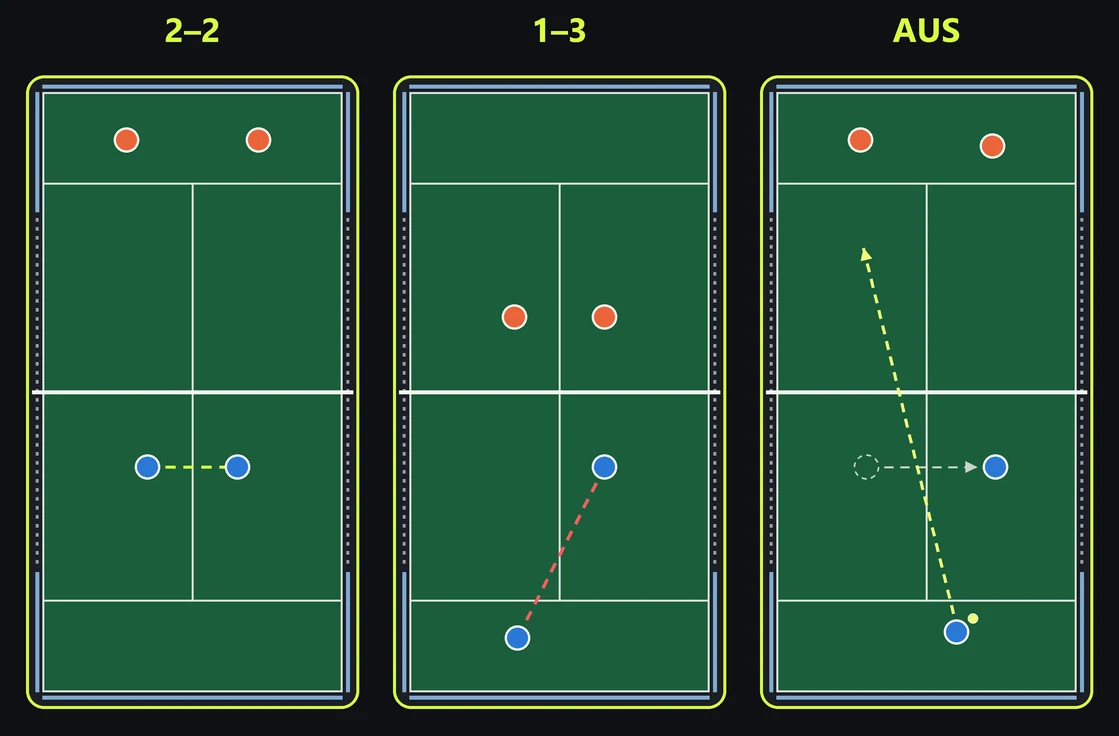
Left to right: the 2-2, the 1-3 and the Australian (AUS). In the Australian, the dotted circle is where the partner usually stands.
The 2-2: the default
Both up to attack, both back to defend. Everything in the sections above is about keeping it. The pair that keeps the 2-2 has no gap in the middle and no open diagonal.
The 1-3: get out of it
If you are the one at the back, your pair is split, and the middle court in the picture above shows the gap it leaves. Get both of you back to the same line: a deep lob gives you the time to come up, or your partner drops back to you. If you are on the pair with two at the net against a split pair, coaches advise playing at the player at the back and through the middle, and using the angles the player at the back can’t reach.
The Australian: a change of serve, not a trick
The FIP Rules let the server’s partner stand anywhere on their side (Rule 3.2), so the formation is legal. The server starts nearer the middle and the partner covers the other half. A study of Spanish national-level and beginner players found it did not win more serve points than the usual formation; it changed where the serves went. Use it to break a returner’s favourite cross-court return, sometimes, not every point. More in padel serve tips.
Try it
For one set, say “Up!” every time your lob goes deep, and both of you move in. Count the points you lost while one of you was at the net and the other at the back.
Film your next match and check it in Padelapu: rewatch the points, see where you both stood, send your partner the exact moment. Free, no card needed.
Sources
- International Padel Federation, Rules of Padel (review of application 01.01.2026): The court (the service line 6.95 m from the net), Rule 3.2 and Rule 6.1 (where the players may stand), Rule 13.1a and 13.1f (touching the net, hitting the ball before it crosses).
- Babolat, “Padel tactics” (2025): the red, orange and green zones.
- LTA Padel, “Padel match tactics” and “Volleys”.
- The Padel School, “Moving as a pair”, “Serve formation: where to stand?” and “The best net position”.
- Ramón-Llin J, Guzmán J, Martínez-Gallego R, Vučković G, Muñoz D, Sánchez-Alcaraz BJ. Comparison of service tactic formation on players’ movements and point outcome between national and beginner level padel. PLoS One 2021;16(10):e0250225.
- Padel-rules.pages.dev, “Padel formations explained: 1-3, Australian, and when to use each” (the 1-3 definition; an independent site, not the FIP).