Tell your partner when the ball might go out: free points in padel
Updated 13 November 2026
In padel the opponents’ ball must bounce on your side before it touches your glass or fence. If it flies straight into the wall, they lose the point, but only if nobody on your side touches it first. Hard balls often fly long or wide. The player about to hit is busy getting ready; their partner has the better view of the flight. Call it early: “Check!” (it might fly out) or “Leave it!” (it’s going straight into the glass).
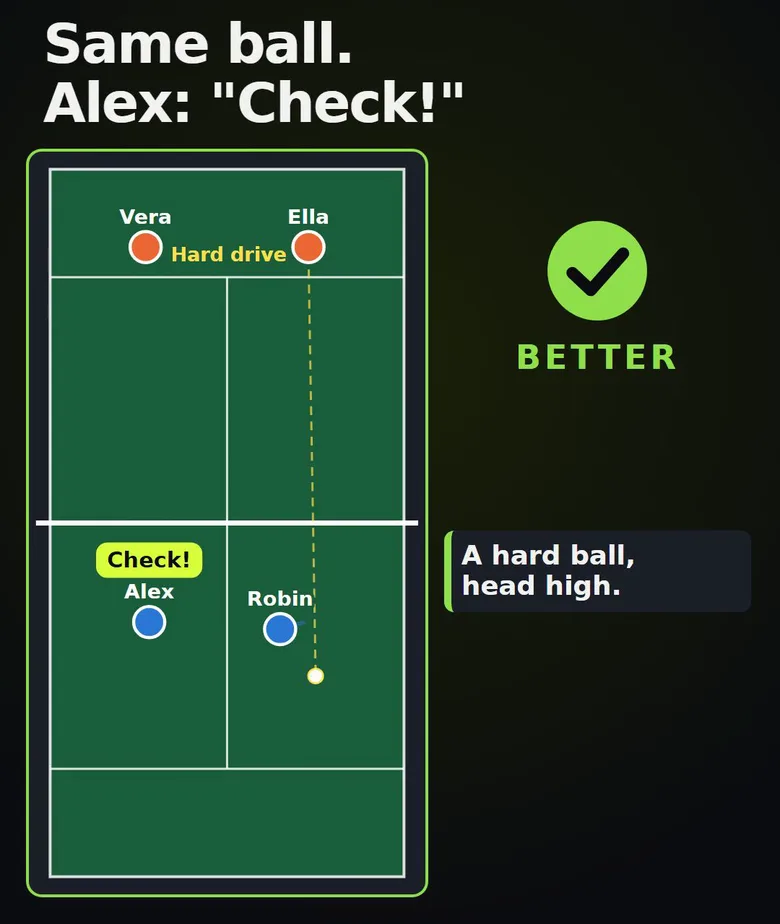
The picture is from our short video on this call; the same play is shown first without a word, then with it.
The rule behind it
The FIP Rules of Padel say a pair loses the point when its ball, without bouncing first, hits the opponents’ walls, fence or anything outside their court. That is padel’s “out”. And a ball that you volley is in play, wherever it was going. Touch it and the free point is gone.
Which balls fly out
- Hard flat drives from the back that are still rising as they cross the net.
- Smashes and hard overheads hit too long: they fly at the back glass, not the floor.
- Wide balls heading for the side fence near the net at shoulder height.
- Lobs pushed too long that are still high over the service line.
The softer and lower the ball, the more likely it drops in. The faster and higher, the more likely it flies.
Who calls it
The one not hitting. The player the ball is coming to is turning, stepping and preparing their swing, so they read the ball late. You are beside them with nothing to do on this ball but watch its flight.
When and how
- Early: as soon as you see the flight, before your partner commits to a volley.
- Once, short: “Check!” or “Leave it!”, not “I think that’s going long”.
- Then stay ready. If the ball dips in, it comes off the glass and you are still in the point (see why “check” and not “out”).
For the one hitting: keep your racket ready, but don’t swing at a ball you were told to check until it bounces. Let it go past if it’s above your shoulder and still rising. If it lands, play it off the glass.
Sources
- International Padel Federation, Rules of Padel, review of application 1 January 2026: losing the point (a ball that hits the opponents’ walls or fence before bouncing) and a good return (a ball volleyed by the opponents is in play).
- Which balls tend to fly out is our coaching judgement, not a measured rate.
Hear it on your own video
Film a match, tag the points you lost down the middle or off a lob, and send your partner the exact moment. Free in Padelapu, no card needed.
More guides
- Padel communication: all six callsAll six calls on one card, and four rules for any call.
- Say “check”, not “out”Why “out” makes your partner stop too early.
- Tell them where the opponents are“Both up!” when your partner chases a lob.
- Padel rules for beginnersThe court, the serve, scoring and what the walls allow.